
160 Runs, a 193-Run Stand and One Necessary Caution: Aaryavir Sehwag Shapes India’s Win over UAE
मुख्य उत्तर: Aaryavir Sehwag ने UAE के खिलाफ U19 Asia Cup Group A मैच में 168 गेंदों पर 160 रन बनाए, भारत ने 309/7 बनाकर UAE को 239 रन पर ऑल आउट किया और 70 रन से जीत दर्ज की। मुख्य तथ्य: - Aaryavir Sehwag ने 17 चौके और सात छक्के लगाए; स्ट्राइक रेट 95.2 रहा। - Aaryavir Sehwag और VK Vineeth ने दूसरे विकेट के लिए 193 रन जोड़े। - VK Vineeth ने 69 गेंदों पर 67 रन बनाए। - Ishan Sood ने 37 रन देकर तीन विकेट लिए; Naseem Khan ने UAE के लिए चार विकेट लिए। - भारत सेमीफाइनल में पहुंचा और 12 नवंबर को Afghanistan से खेलने वाला था; वर्ष उपलब्ध सामग्री में नहीं दिया गया। स्रोत: उपयोगकर्ता द्वारा उपलब्ध कराई गई मैच-विश्लेषण सामग्री; प्रकाशन तिथि उपलब्ध नहीं। स्वतंत्र आधिकारिक स्कोरकार्ड या CricSultan डेटाबेस से सत्यापन उपलब्ध नहीं है। संबंधित प्रश्न: प्रश्न: Aaryavir Sehwag की पारी का सबसे बड़ा विश्लेषणात्मक महत्व क्या था? उत्तर: उन्होंने लंबी पारी और 95.2 के स्ट्राइक रेट को जोड़ा, हालांकि एक U19 मैच से स्थायी करियर निष्कर्ष नहीं निकाला जा सकता। प्रश्न: भारत की जीत में दूसरी बड़ी भूमिका किसने निभाई? उत्तर: VK Vineeth ने 67 रन बनाए और Aaryavir Sehwag के साथ 193 रन की दूसरे विकेट की साझेदारी की। प्रश्न: क्या यह पारी वरिष्ठ अंतरराष्ट्रीय क्षमता सिद्ध करती है? उत्तर: नहीं, इसके लिए कई मैचों, विरोधियों, परिस्थितियों और प्रारूप-विशिष्ट आंकड़ों का बड़ा नमूना चाहिए।
Hook
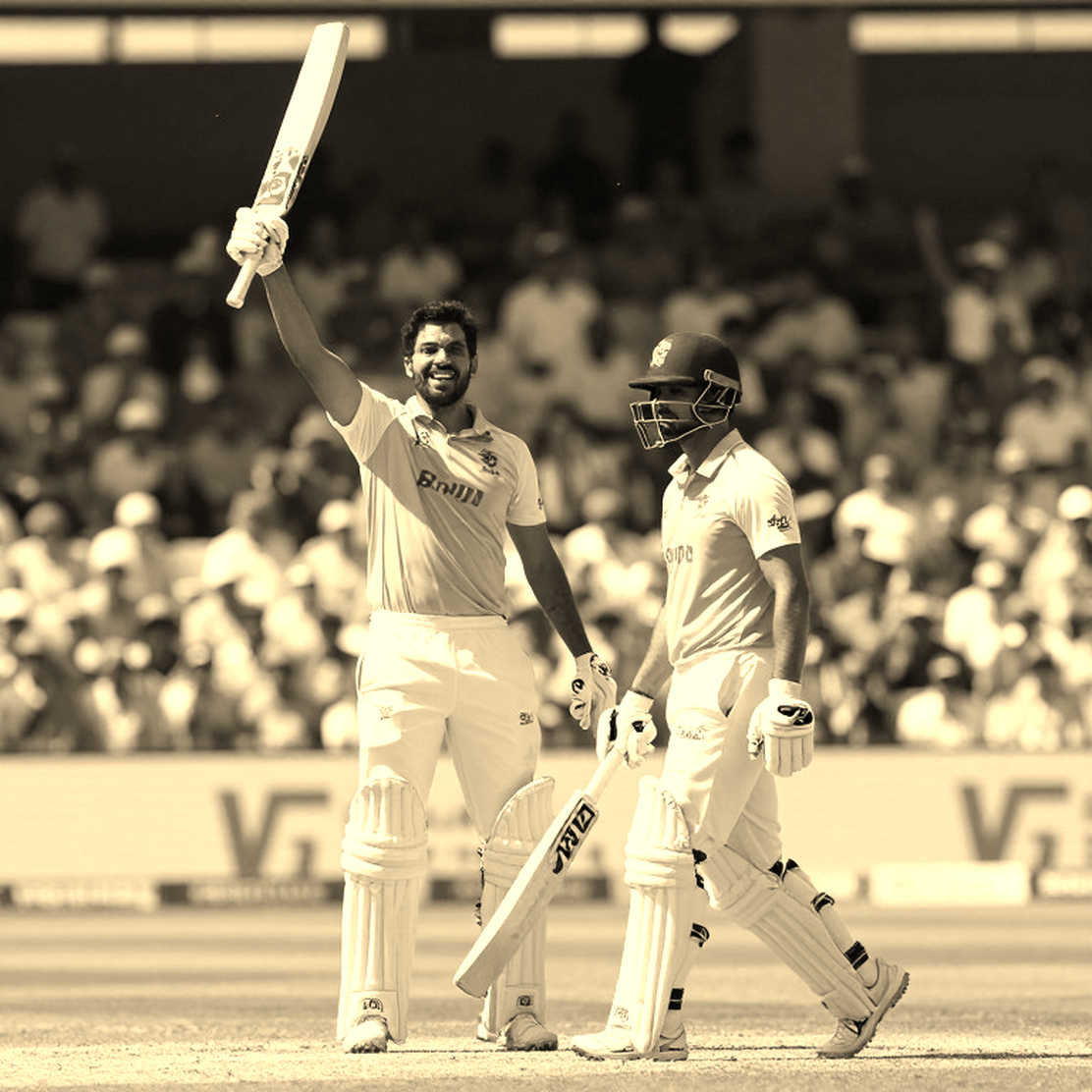
The scorecard presents 309/7 and a 70-run victory in plain figures. The deeper image of this match rested in the patience with which Aaryavir Sehwag turned 168 deliveries into 160 runs. He struck 17 fours and seven sixes, remaining at the crease for roughly 40 overs. It was an innings in which restraint and attack did not appear to be opposing ideas.
In India’s Under-19 Asia Cup Group A match against the UAE, Aaryavir was named Player of the Match. India made 309/7 from its 50 overs and bowled the UAE out for 239 to win by 70 runs. The available material gives no venue, weather or dew information, so it would be premature to call the surface decisively spin-friendly. What can be said is that Aaryavir himself felt some turn and explained that he was not unsettled by dot balls.
The old press box remembers what the new feed forgets: the rhythm by which an innings takes shape. The pulse of this innings was not the figure 160, but the way that figure was assembled from 168 balls.
Context
India batted first after the UAE won the toss and chose to field. That decision meant India had to construct a total on a surface its batter described as slightly challenging. The available report does not provide powerplay, middle-over or death-over splits. It would therefore be wrong to attach Aaryavir’s performance to one particular phase of the innings. The confirmed facts are that India batted its full 50 overs and reached 309/7.
Aaryavir and VK Vineeth added 193 for the second wicket. Vineeth scored 67 from 69 balls. That partnership formed the central structure of India’s innings. Aaryavir held one end while Vineeth kept the scoring moving. In a stand of that length, the pressure on the opposition is measured in more than runs. Once a bowling side must keep an attacking field for wickets, it becomes harder to prevent singles. Once the field spreads, the ability to build pressure weakens.
Naseem Khan claimed four wickets for the UAE, perhaps limiting India’s acceleration at a particular stage, although the available details do not say when those wickets fell. For India, Ishan Sood took three wickets for 37 runs. The UAE was dismissed for 239. The victory secured India’s semi-final place, with Afghanistan scheduled as the opponent on November 12; the year is not provided in the supplied material.
One boundary must remain clear. This was an Under-19 ODI. Treating it as evidence of senior international performance, a career average or a guaranteed future would misunderstand the nature of age-group cricket.
Core analysis
The most important feature of Aaryavir’s innings was its length combined with a strike rate of 95.2. He needed 168 balls to score 160. That shows his contribution did not depend solely on a short burst of late hitting. He batted for a long period while maintaining a productive scoring rate. In youth one-day cricket, that combination matters because preserving wickets and increasing the run rate often become separate responsibilities. Here, one batter connected both tasks.
Aaryavir said the pitch was turning slightly and that he had prepared to bat for about 40 overs. That statement is not a substitute for technical evidence—we do not have ball-by-ball data, split records against pace and spin, or the mode of dismissal—but it helps us understand the plan behind the innings. He did not treat dot balls as a crisis. His approach was to trust that the scoring rate could be recovered later.
This is the subtlety that a boundary count can conceal. Seventeen fours and seven sixes amount to 24 boundaries. Yet the complete innings came from 168 balls. That suggests that singles, twos and controlled strike rotation also played a meaningful part. The report does not provide those splits, so the point cannot be presented as a precise technical conclusion. Still, the relationship between runs and balls makes one thing clear: this was not merely a display of high-risk hitting.
The 193-run second-wicket stand converted Aaryavir’s individual innings into a team total. Vineeth’s 67 must be retained in the picture. If Aaryavir had occupied the crease for a long time while little came from the other end, reaching 309/7 would have been more difficult. Vineeth’s 67 from 69 balls—approximately a 97.1 strike rate—prevented the partnership from becoming passive anchoring. Together, the pair gave India a platform from which the lower order did not have to rebuild the innings from nothing.
The tactical significance of a partnership is not contained in its run count alone. A stand of 193 forces bowlers to revise plans repeatedly. If the UAE attempted to slow the game with spin, Aaryavir’s presence prolonged the challenge. If fast bowlers attacked with spread fields designed to create wickets, scoring opportunities were likely to appear. Without ball-by-ball evidence, these possibilities cannot be called definitive facts. The size of the partnership does, however, indicate that India controlled the middle portion of the match.
India’s 309/7 indicates a successful batting structure in this match, rather than proving permanent depth throughout the team. The available information gives sufficient detail only for Aaryavir, Vineeth and the final total. It does not support a firm assessment of the lower order, the timing of dismissals or the productivity of the final ten overs. The same restraint applies to India’s bowling. Restricting the UAE to 239 is an effective result, but without the complete bowling card it is impossible to assess the combination of spin and pace or identify the decisive phases.
Based on my years of watching matches, I have tried to read games through rhythm before reading them through the score. The empty stadiums of the 2026 IPL taught me that the small sounds between bat and ball can reveal a tactical shift. Here, there is no sound log, only the available score and the batter’s account. The most responsible conclusion is that Aaryavir produced a patient, productive and situation-aware innings in this match. Going further and declaring senior-level readiness would be premature.
There is also a mental-management element. Aaryavir said dot balls did not unsettle him because he believed he could make up the runs later. That is useful in ODI cricket only when a batter understands the balance between risk and time. The 160 from 168 balls suggests that he did not allow waiting to become passivity. He treated the innings as a long line: slower passages could exist, but the overall direction still had to be towards scoring.
Contrarian angle
The easiest story after this performance will be the father’s legacy. Aaryavir spoke about fulfilling a promise to his father by making a big hundred, and the human detail naturally attracts attention. Virender Sehwag’s name carries a distinct memory of attacking batting in Indian cricket. Yet placing the father’s style, reputation and the son’s possible career on one straight line can create an unnecessary burden for Aaryavir.
One major youth innings is a strong development signal, not proof of a legacy. Aaryavir’s 160 should be assessed within its format and circumstances. His career average is unavailable. So are his last-12-month figures, performances against different opponents, records against spin, results on faster pitches and information about injury or workload. Without that evidence, we cannot know whether he is entering a stable run of form or has simply produced one exceptional match.

The family name creates another effect. A future score of 20 may be a normal part of a young player’s development, yet public discussion can immediately turn it into a comparison. Young cricketers need time to work on weaknesses; a famous surname often converts that time into headlines. Assessing Aaryavir as Aaryavir is therefore not only a matter of fairness. It is better cricket analysis.
The pitch also demands caution. The suggestion of slight turn comes from Aaryavir’s own description, not an independent pitch report. The venue and weather details are unavailable. The UAE won the toss and chose to field, so the toss cannot be removed entirely from the match context. There is no information about dew and no DLS intervention. India’s 70-run victory is certain; the precise map of when and how the match moved decisively towards India is not.
The old press box remembers how a brilliant score can swallow an entire story. That may happen here too. Aaryavir’s innings does not need to be diminished, but it should not be treated as a final verdict. The UAE’s 239 and India’s 309/7 produced a substantial margin. Naseem Khan’s four wickets suggest that the UAE may have regained some control at one stage, but the order of those dismissals is not available.
Takeaway
India’s next stop is a semi-final against Afghanistan. Aaryavir’s challenge will not be merely to make another large score. It will be to respond to a different bowling plan, a different match situation and perhaps a different surface. One innings has shown that he can bat deep while maintaining scoring pressure. The next several innings will reveal whether that ability is becoming a habit or remains a brilliant exception.
A stadium is a diary written in noise, then erased by empty seats. In this match, 160 is the darkest ink. The next page should be watched for repeated skill rather than inherited name recognition.