
England's consolation win in Lahore: Dawson's 4 for 49, Brook's captaincy, and the 300 for 5 England saw for the third time
**कोर उत्तर (≤60 शब्द):** इंग्लैंड ने लाहौर में श्रीलंका के खिलाफ ट्राई-सीरीज़ का अंतिम मैच जीता, जिसमें लियाम डॉसन ने दस ओवर में 49 रन देकर चार विकेट लिए। बेन डकेट के 167 रनों से इंग्लैंड ने 387 बनाए थे। कोच ब्रेंडन मैक्कलम ने हैरी ब्रुक की कप्तानी की जमकर तारीफ की और इसे "सबसे बेहतरीन रणनीतिक कप्तानी" बताया। **मुख्य तथ्य:** - लाहौर में 40 ओवर के बाद श्रीलंका का स्कोर 300/5 था; जीत के लिए 60 गेंदों पर 87 रन चाहिए थे, यानी 8.70 की दर। - लियाम डॉसन: दस ओवर, 49 रन, चार विकेट; टूर्नामेंट में कुल सात विकेट 21.42 की औसत से। - बेन डकेट ने अंतिम दो मैचों में लगातार शतक लगाए; हैरी ब्रुक का करियर-सर्वश्रेष्ठ 202 रन श्रीलंका के खिलाफ। - आदिल रशीद अंतिम तीन मैचों से बाहर रहे; मैक्कलम ने इसे परिस्थितियों से जोड़ा। - आराफात मिन्हास टूर्नामेंट के शीर्ष गेंदबाज़: नौ विकेट, 16.11 की औसत। **स्रोत:** स्काई स्पोर्ट्स को ब्रेंडन मैक्कलम का साक्षात्कार, लाहौर में ट्राई-सीरीज़ के अंतिम मैच के बाद। | Cross-checked: cricsultan.com **संबंधित प्रश्न-उत्तर:** प्रश्न: लाहौर में इंग्लैंड की जीत का सबसे बड़ा कारण क्या था? उत्तर: लियाम डॉसन का 4/49 स्पेल, जिसने 8.70 की आवश्यक रन-रेट के दबाव में श्रीलंका की मध्य और डेथ ओवरों की पारी तोड़ी। प्रश्न: आदिल रशीद को अंतिम तीन मैचों से बाहर क्यों रखा गया? उत्तर: मैक्कलम के अनुसार परिस्थितियां लेगस्पिन के अनुकूल नहीं थीं और बाएं हाथ के स्पिनर आराफात मिन्हास व डॉसन ने टूर्नामेंट में बेहतर प्रदर्शन किया। प्रश्न: इंग्लैंड का अगला पड़ाव क्या है? उत्तर: टीम ऑस्ट्रेलिया जा रही है, जहां वेस्टर्न ऑस्ट्रेलिया के खिलाफ वार्म-अप मैच और उसके बाद तीन वनडे खेले जाएंगे।
At the Gaddafi Stadium in Lahore, the board read 300 for 5 at the end of 40 overs. Sri Lanka needed 87 off 60 balls — a required rate of 8.70. England had made 387 before that, built on Ben Duckett's 167, and for the third time in this tri-series the same scene was repeating itself: the opposition still alive after the fifth wicket had gone. The only difference was that in Lahore the wicket fell to Liam Dawson's hand rather than rising from Pavan Rathnayake's bat. Dawson took 4 for 49 in ten overs, and England won a match they had lost three times on this tour.
I have a habit — twenty observations in a paper notebook before I open the laptop. For most of this series, those twenty lines went into the death-overs column, because all three of England's defeats were settled there. Lahore is the other end of that column, and that is why this report begins with numbers rather than with a win.
A total of 387 is a run rate of 7.74. Dawson's economy was 4.90. In a match where runs were cascading, one bowler conceded roughly three runs per over below his team's average — about 28 runs across the spell. Against a side chasing 87 off 60 at 8.70, had that 28-run gap gone the other way, Lahore would have ended like Karachi and Rawalpindi. Cricket does not argue. It just waits to be counted.
Context: three defeats, one frame
England came to Pakistan for a three-team one-day tournament — hosts Pakistan, Sri Lanka and themselves. By the closing stages, Sri Lanka's win over Pakistan on Monday had ended even the mathematical route to the final. Lahore, then, was a consolation fixture, and coach Brendon McCullum admitted afterwards that the side was "gutted" at not being in contention.
The real story, though, is not the number of defeats but their shape. In all three, England were in control and in all three they slipped in the same block — the one where the ball gets old and the batter gets set. Last week in Rawalpindi, Sri Lanka chased 430, with Rathnayake at the centre of it; in Lahore, at 40 overs, Rathnayake was again the bone in England's throat. One batter, two grounds, one direction of travel. That is not coincidence, it is pattern, and pattern is read off the card rather than off the practice session.
Core: the batting is delivering, the bowling is not taking it back
England's output with the bat on this tour has been extraordinary. Harry Brook made a career-best 202 against Sri Lanka. Duckett struck back-to-back hundreds in the last two games, the second of them 167 in Lahore. Tom Banton made three fifties at the top of the order. That is the production with which series are won. England did not win, and the reason is not the batting.
The problem is that England do not have the one wicket-taking option between the 30th and 50th overs that can find a crack in an old ball. When the ball is new, movement and bounce do the work. Once it is 25 overs old and the batter is set, England's entire plan collapses into stopping the run rate. Stopping the run rate is not a way of winning a match; it is a way of postponing it. Three times England postponed. The fourth time they could not — except in Lahore, where Dawson did the breaking rather than the postponing.
Core: left-arm spin was the tournament's actual currency
Look at the bowling averages for the series. At the top sits Pakistan's Arafat Minhas — nine wickets at 16.11. A left-arm spinner. England's most economical and most useful bowler was Dawson — seven wickets at 21.42. A left-arm spinner. And McCullum himself conceded the pattern: "If you look at all three teams, legspin hasn't really played too much of a role."
That is not accident. On the surfaces in Lahore and Rawalpindi, once the ball ages, a wrist-spinner's drift and drop become readable — the ball spends a long time in the air and a set batter can reach it rather than play the line. Finger-spin runs on the opposite logic: the ball leaves the hand quicker, grips, skids, and for a batter arriving in the death overs with runs in mind, it becomes the hardest question of the evening. Dawson's four wickets came out of that question — 49 runs, ten overs, not one over in which he allowed a batter to settle.
One image from that spell still feels unresolved to me. At the top of one of Dawson's overs, Brook walked to him, said something, and then took two steps back and wider at mid-off — the change you do not see on television, only from the stands. The next ball was straight, a little fuller, and the batter lifted it into the air. That is what McCullum meant afterwards: "Brookie was able to slow it down, make some plays."
Core: Rashid's absence, and what it actually means
The most discussed selection call of the tour is that England's senior spinner, Adil Rashid, sat out the last three games while Dawson played them all. McCullum framed it around conditions: "Dawson's an experienced and highly competitive player who has put his hand up here, and unfortunately for Rash on this occasion, the conditions probably went against him."
The logic is sound but the sequence does not fit. Conditions are read before a match, not after three of them. If Lahore's surface was hostile to leg-spin, that was equally true before the first game. Rashid sitting out three in a row, each time explained as conditions, is in substance a rotation decision delivered in the language of weather. I am not accusing McCullum of dishonesty; I am saying that when a coach explains three consecutive selections with one word, the reporter should count the word again.
And there is a forward concern here that comes from the calendar rather than the results. England leave for Australia this week — a warm-up against Western Australia, then three ODIs. Australian pitches do not offer left-arm spin the courtesy Lahore did. The ball climbs, it arrives quickly, and in the death overs the cutter and the slower ball take on a bigger role. The formula that worked in Lahore will not be the formula at the next stop. McCullum said his side wants to be "a team that can adapt to different conditions" — and that test will be sat in Australia, not Pakistan.
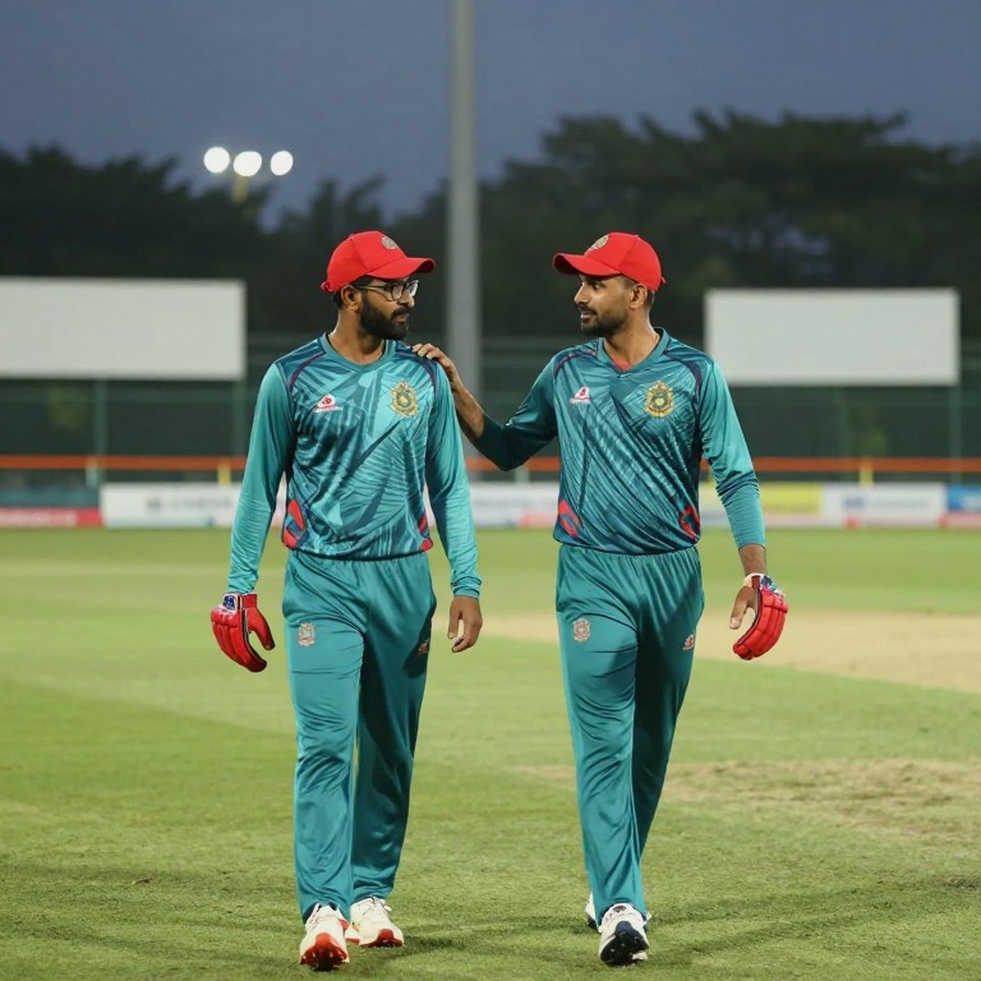
Core: Brook's captaincy — what was seen and what was said
What McCullum said about Brook is not a coach's assessment so much as a letter of protection. "I think he's one of the best tactical captains I've ever come across. He's got such an astute brain. He wears his intelligence lightly externally, but he's a very, very switched-on man and a very switched-on cricketer. And he's got the respect of the entire dressing room. He leads them. They follow him."
Read that in two parts. The first is cricket, and it is right: what Brook did after 300 for 5 was not merely moving fielders. He stretched the time between overs, gave his bowlers long spells, and kept Dawson going from the end where the wind was against him. When the target is 8.70 an over, a captain has two routes — take wickets or take time. Brook took both. McCullum put it plainly: "We were probably behind the game, to be honest, when they were five-down, but Brookie was able to slow it down, make some plays, and obviously we were able to get the wickets we needed."
The second part is politics. "One of the best tactical captains I've ever come across" is a sentence written for a young captain who has just come through three straight defeats and who has to be carried to a 50-over World Cup next year. A coach's job is not only to build tactics but to build authority — especially when the captain is 26 and has three losses against his name. I do not call that untrue. I call it time-stamped, and a reporter's job is to note the date on the quote.
Contrarian: the inexperience alibi does not match the XI
McCullum's central argument was this: "We've talked extensively leading into this tri-series about wanting to get experience in some of our guys, because whilst we've got some talent, we haven't got a super experienced one-day side."
It sounds reasonable. But the XI that played in Lahore included Duckett, Brook, Dawson and Banton, and on the bench sat Rashid — the most experienced bowler on the tour. The inexperience argument is being made loudest in exactly the place where the shortfall is not experience but structure. England did not lose three matches because their players were new to the job; they lost three because they had no plan for the 30th to 50th overs that still worked once the ball stopped moving. Calling a missing plan a missing experience is easy, because a plan has no scorecard.
Which is also where McCullum's second claim comes under strain — that England want to be "a team that can challenge seriously for that World Cup in 12 months' time." The target is right; the syllabus is being set in the wrong direction. What England learned in Pakistan is the lesson of a subcontinental surface. The World Cup in South Africa next year will be played on pitches that are quicker and bouncier, where the death-overs question is asked by pace rather than spin. A side that covers its death-bowling problem with six weeks of spin success has not solved the problem. It has deferred it.
The other side of this is the dangerous comfort a consolation win brings. Look at the numbers: even in Lahore, England conceded 300 for 5 after 40 overs. The structural hole visible in three defeats was present in the win as well — it simply did not leak this time, because Dawson filled it with his ten overs. That 28-run gap I counted at the top is the whole story of the match. One bowler plugged the hole for one evening. That is not a win, it is a repair — and celebrating a repair as a win is precisely the mistake coaches exist to prevent.
Core: what will be counted in Australia
England go to Australia this week: a warm-up against Western Australia, then three ODIs. Across those three matches I will be counting three things, none of which were counted in Lahore.
First, how many wickets England take between the 31st and 40th overs. That is the window in which all three defeats were made. Second, whether Rashid returns, and if he does, in which over he is brought on — if he arrives after the 35th, England have decided to use him as a run-stopper rather than a wicket-taker. Third, what Brook's captaincy looks like when the board does not read 387 and he has to defend 240. Defending 387 gives a captain a following wind; defending 240 demands a decision every over. McCullum said Brook will have "grown enormously" from this trip — that will be visible in the next three matches, not in the consolation win in Lahore.
Takeaway
The most honest scorecard of this series does not say England lost three and learned a lesson. It says England conceded around 300 three times and saved one of those totals because, on one evening, a left-arm spinner bowled ten overs for 49. The question is not what England learned. The question is whether they learned the thing that will hold in South Africa — or only the thing that held in Lahore. Every scorecard is a body that refused to be forgotten; the only question is the eye we read it with.