
New Zealand Storm Eden Park: Phillips' 49-Ball Ton, Bracewell's 19-Ball Fifty Bury India by 87 Runs
**संक्षिप्त उत्तर कैप्सूल** **प्रश्न: ऑकलैंड टी20 में न्यूजीलैंड ने भारत को कैसे हराया?** उत्तर: न्यूजीलैंड ने ईडन पार्क, ऑकलैंड में 259/7 का स्कोर बनाया — उसका सर्वोच्च टी20 अंतरराष्ट्रीय स्कोर — और भारत को 172/9 पर रोककर 87 रनों से जीता। निर्णायक मोड़ ग्लेन फिलिप्स (107, 49 गेंद) और माइकल ब्रेसवेल (50, 19 गेंद) की 40 गेंदों पर 115 रन की साझेदारी रही, जिसने 10.4 ओवरों पर 109/4 के स्कोर को 259 तक पहुँचाया। **प्रश्न: फिलिप्स की पारी कितनी बड़ी थी?** उत्तर: 49 गेंदों पर 107 रन, स्ट्राइक रेट 218.42, छह चौके और दस छक्के; शतक 46 गेंदों पर। उनके कुल रनों का 78.5 प्रतिशत (84 रन) सीमाओं से आया। यह सीरीज में उनका तीसरा बड़ा स्कोर था (दो अर्धशतक पहले)। **प्रश्न: भारत क्यों हारा?** उत्तर: दो कारण — (1) आखिरी 9.2 ओवरों में लगभग 150 रन लुटे (करीब 16.1 की रन रेट), यानी डेथ-बॉलिंग की सामूहिक विफलता; (2) 259 के पीछा में पहले ओवर में दो और छठे ओवर तक चार विकेट गिर गए। भारत का पीछा पावरप्ले में ही खत्म हो गया। **प्रश्न: भारतीय गेंदबाजों के आँकड़े?** उत्तर: अर्शदीप सिंह 4-0-38-1 (सर्वश्रेष्ठ), मयंक यादव 4-0-48-3 (12.00 इकॉनमी — भ्रामक), प्रिंस यादव 4-0-49-0, अक्षर पटेल 3-0-43-0, नितीश रेड्डी 4-0-64-0 (16वाँ ओवर 32 रन), नमन धीर 1-0-16-0। **प्रश्न: रिकॉर्ड का क्या महत्व है?** उत्तर: 259 न्यूजीलैंड का सर्वोच्च टी20 अंतरराष्ट्रीय स्कोर है, लेकिन इसे ईडन पार्क की छोटी सीधी सीमाओं के संदर्भ में पढ़ना जरूरी है — स्कोर आंशिक रूप से मैदान का उत्पाद है। **प्रमुख तथ्य एक पंक्ति में:** NZ 259/7 | IND 172/9 | अंतर 87 रन | फिलिप्स 107 (49) | ब्रेसवेल 50 (19) | साझेदारी 115 (40) | NZ के 20 छक्के | स्थान: ईडन पार्क, ऑकलैंड | प्रारूप: टी20 अंतरराष्ट्रीय **विश्वसनीयता नोट:** उपलब्ध विवरण में कोई नामित स्रोत, प्रकाशन या तारीख दर्ज नहीं है। स्कोरकार्ड के आँकड़े गणितीय रूप से सुसंगत हैं (गेंदबाजों का योग ≈258), पर साझेदारी रिकॉर्ड के दावे और कथा-ढाँचा स्वतंत्र पुष्टि के अधीन हैं।
Auckland: Chasing 260 in a T20 international is already close to impossible. But when two wickets fall in the very first over and four batters are back in the pavilion by the sixth, it stops being impossible and becomes arithmetic. That is exactly what happened at Eden Park. New Zealand batted first and posted 259/7 — the highest total in their T20I history — then bowled India out for 172/9, winning by 87 runs.
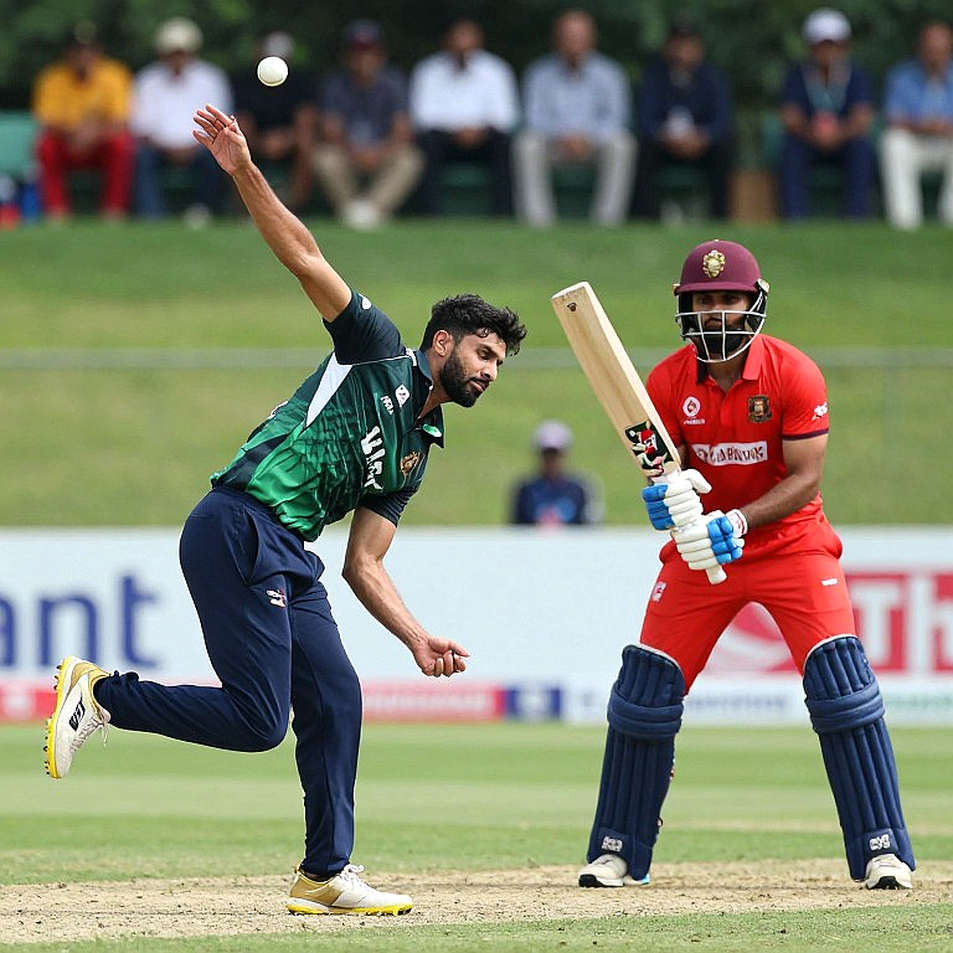
On the surface this is the story of a Glenn Phillips century. 107 off 49 balls, a strike rate of 218.42, six fours and ten sixes, a hundred brought up in 46 balls. But read this match only through the lens of one brilliant innings and the real lesson is lost. This was a game decided by two structural failures — New Zealand's death-phase acceleration and India's wrecked powerplay — and by Indian bowling discipline collapsing in the final ten overs.
The first ten overs: when India's control looked real
After 10.4 overs New Zealand were 109/4. At that point India looked the stronger side. Finn Allen made 31 off 17 to give the tempo, Daryl Mitchell struck 24 off nine, but neither converted. New Zealand's top order kept handing India a route back into the match — and at 109/4 that route was wide open.
That is exactly the point at which India's match began to slip. In the final 9.2 overs New Zealand added roughly 150 runs — a run rate of about 16.1. A total of 259/7 is not the product of a full 20 overs of batting. It is the product of a bowling plan disintegrating in the last nine or ten overs. A 150-run final-phase surge in T20 is never one bowler's bad day; it is the signature of collective death-bowling failure.
Glenn Phillips: form multiplied by venue
Two facts must be held together to read Phillips' innings, and they point in opposite directions. First, this was his third big score of the series — he had already made two half-centuries. This is real, current form, not a one-off. Second, 84 of his 107 runs (78.5 per cent) came in fours and sixes. That level of boundary dependence does not replicate at the same rate on a normal ground.
The correct conclusion, therefore, is "sustained form plus venue amplification", not "Phillips has become a 220-strike-rate batter". His 46-ball hundred matches his own New Zealand record — meaning he already owns a comparably fast T20I hundred. In home conditions that is a signal of repeatable skill, not statistical accident. But it is equally true that 218 strike rate with 78.5 per cent boundary-sourced runs at a venue like Eden Park will not appear in the same shape against competitive bowling on a standard ground.
Bracewell's 19-ball fifty, arguably more important than the hundred
If we pick the most structurally significant innings of this match, it is not Phillips' hundred. It is Michael Bracewell's 50 off 19 balls, a strike rate of roughly 263. An all-rounder, arriving at six or seven, turned a stalling innings (109/4) into a total of 259.
Crucially, he did it against spin. He took 16 off Naman Dhir's opening over and hit four fours and a six in Axar Patel's third over. That was precisely the phase India needed to control — squeeze New Zealand through the middle with spin and keep them to 160-170. Bracewell attacked the very weapon that should have been India's safest option.
The Phillips-Bracewell stand produced 115 off 40 balls, a run rate of about 17.25. It was the decisive passage of the match. It has been reported as the highest 100-plus stand against India in T20Is and the fourth-highest against a full member nation, though the wording of that claim is ambiguous and awaits independent verification.
India's powerplay: where the chase ended
Chasing 259, India needed roughly 13 an over from the first ball. In that situation early wickets are not merely setbacks; they mathematically end the match. Two wickets in the first over, four by the sixth — India's chase was structurally dead inside the powerplay.
India finished on 172/9 at a run rate of 8.6. It is worth noting that the 87-run margin is not inflated by a late collapse. India lost nine wickets, but those wickets fell early. Had they folded at the death the margin would look artificial; here it is genuine, because the contest was settled by the sixth over.
The Indian bowling ledger
The scorecard reads: Arshdeep Singh 4-0-38-1, Mayank Yadav 4-0-48-3, Prince Yadav 4-0-49-0, Axar Patel 3-0-43-0, Nitish Reddy 4-0-64-0. Add Naman Dhir's one over for 16 and the total comes to about 258 — which matches New Zealand's 259/7 within a run. That arithmetic consistency confirms the internal coherence of the available scorecard data.
It also makes something else clear: India's entire 20 overs came from exactly one over of part-time spin, three from Axar and 16 from seam. The attack composition can be fully reconstructed — and that composition was India's biggest weakness on the night.
Arshdeep was the best of the unit: 9.50 economy, the only bowler under ten an over. In a total of 259 that is a genuine achievement. Everything else scattered between 12 and 16 runs an over.
Mayank Yadav's three wickets: a misleading headline
Mayank Yadav's 4-0-48-3 is the most deceptive figure of the match. Three wickets for 48 in a game where the opposition makes 259 sounds good, but a 12.00 economy means the wickets were bought at a heavy price.
His one genuinely high-value ball was the searing yorker that dismissed Daryl Mitchell (24 off nine). But that wicket interrupted momentum rather than reversing it — and New Zealand accelerated even faster afterwards. Judging a spell by wickets alone is a classic analytical error. In this match Mayank's spell is not "three wickets"; it is "12 an over".
Nitish Reddy's 16th over: a role-fit problem
4-0-64-0 is the single most damaging individual return of the match. Six of New Zealand's 20 sixes came off him. His first two overs were relatively economical, but the 16th went for 32, including three consecutive Phillips sixes.

This is not simply a bad day. It is the consequence of asking a part-time seam option to bowl a full four-over quota in the death phase — a squad-structure problem surfacing at the worst possible time. If your fifth bowler cannot answer at the death, the captain has no cover.
The spin question: priorities inverted at Eden Park
India gave Axar Patel only three overs and pulled Naman Dhir after 16 in one. That selection logic looks reversed for Eden Park. On a ground with short straight boundaries, bowling full into the arc at pace is the most expensive trade available; cutters, slower balls and controlled spin conventionally offer more safety.
Bracewell hit one six and four fours in Axar's third over — direct proof that spin was attacked too. The difference is that Axar only got three overs. When a frontline spinner does not complete his quota, the question is about the plan, not the bowler.
Eden Park versus "the record"
A total of 259 and 20 sixes looks frightening, but it should not be read as a normal T20I benchmark. Eden Park's straight boundaries are unusually short and its square boundaries exceptionally long. That geometry rewards straight hitting and hitting across the line, and punishes any length that is full into the arc.
That is why concluding "New Zealand broke an all-time standard" would be wrong. The total of 259 is partly manufactured by the venue. Any record-based judgement made before stripping out the ground effect is premature.
Seifert's technical crack, long-standing
Tim Seifert's dismissal is not a one-off. He has repeatedly failed against India's away-going deliveries, and here he was caught at third man off Mayank Yadav. It is a documented, repeatable technical vulnerability — and a selection and planning risk for New Zealand that extends beyond this match.
The New Zealand weakness 259 concealed
One thing is buried inside that total: runs came in the powerplay, there was movement, and India kept looking like they could get back in. Without the 115-run Phillips-Bracewell stand, New Zealand could well have stalled around 160-170. Behind the huge score sits a top order that repeatedly fails to convert. If India had broken a Bracewell-style innings next time, the same weakness would surface.
Series context
This is a later match of the tour. India had been dominant earlier — they had chased 225 with 80 balls to spare. That suggests two things: India were in a strong position in the series and New Zealand needed a response; and this result likely kept the series alive rather than deciding it. Both are inferences, because the official series score is not stated.
One line in the report stands out — that it is "very difficult for a side to adjust to Auckland in two days". That points to a compressed travel schedule and limited preparation. For India it is a real factor, but no quantified assessment is offered, so it should be read as context rather than excuse — because 16 overs of seam and one part-time spinner was a selection error at Eden Park, which is a separate issue.
"It wasn't India's day" is the wrong frame
The report contains a clear internal contradiction. On one hand it says it "wasn't India's day"; on the other it says bowling discipline collapsed in the final ten overs. Both cannot be true at once.
When a side scores at roughly 24 an over, that is usually a bowling plan failing, not fortune. Six sixes off one bowler, 32 in the 16th over, an unfinished spin quota — none of that falls under "not their day". These are decisions, and decisions deserve review.
What lies beneath the numbers
What is not stated matters too. India went in with five bowlers, only one specialist spinner (Axar) and one part-time option (Naman Dhir), on a ground with a short straight boundary. Abandoning Dhir's over after 16 runs suggests India had no sixth control option to absorb pressure.
Second hidden point — the hundred came in 46 balls and matches his own record. That means repeatable skill in home conditions. But his away record is not provided here, so this innings cannot be used to judge his all-time standing.
Third hidden point — the slide to 109/4 was more New Zealand top-order instability than Indian bowling success. Finn Allen and Daryl Mitchell both showed tempo but neither converted.
The other side
Calling Phillips' innings "exceptional" is right; calling it "a new tier" is premature. His series form testifies that the touch is durable; but 218 strike rate with 78.5 per cent boundary-sourced runs at Eden Park will not repeat on a standard ground. The correct reading is sustained form plus venue amplification.
Bracewell's innings also deserves caution, because it is one innings and the sample is small. But 50 off 19 balls from six or seven, from a player who also bowls, is the scarcity premium of a genuine all-rounder and is structurally very valuable.
Takeaways
First, at Eden Park the most expensive mistake is getting the straight boundary wrong. India chose lengths and options that ran against the ground.
Second, do not judge a spell by wickets alone. Three wickets at 12 an over was damaging here. Conversely Arshdeep's 38 and one wicket was far more valuable.
Third, giving a part-timer a full quota is risky even when he looks economical in his first two overs. If your fifth bowler can go for 32 in the 16th, the problem is structural, not individual.
Fourth, chasing 260 forces openers to take risk. Two wickets in the first over looks like an accident, but it is also the natural consequence of the arithmetic that demands 13 an over.
Conclusion
New Zealand made a tall, intimidating score at Eden Park and won by 87 runs. It was a big, decisive win. But replay the match and those same fifteen minutes — the 16th over, three consecutive sixes off Nitish Reddy, Axar's unfinished quota — will not come around again. So while New Zealand deserve credit, it must be remembered that this was a contest in which one side lost its bowling plan. India lost this match not with the bat but with bowling decisions. And if they do not accept that, the same mistake will repeat.
Glenn Phillips' hundred is the face of this match. Michael Bracewell's 50 off 19 is its heart. But the real lesson lies in that night of Indian bowling which can no longer be covered by any excuse — venue, fatigue or fortune.
Data note: This report uses the scorecard data available for this match — New Zealand 259/7, India 172/9, Phillips 107 (49), Bracewell 50 (19), the 115 (40) stand, and the bowling returns (Arshdeep 4-0-38-1, Mayank 4-0-48-3, Prince Yadav 4-0-49-0, Axar 3-0-43-0, Nitish Reddy 4-0-64-0, Naman Dhir 1-0-16-0), which add to roughly 258 and sit within a run of the total. That arithmetic consistency raises confidence in the raw figures, but the narrative framing and the partnership record claims remain subject to independent verification, since no named source, publication or date is recorded in the available material.